
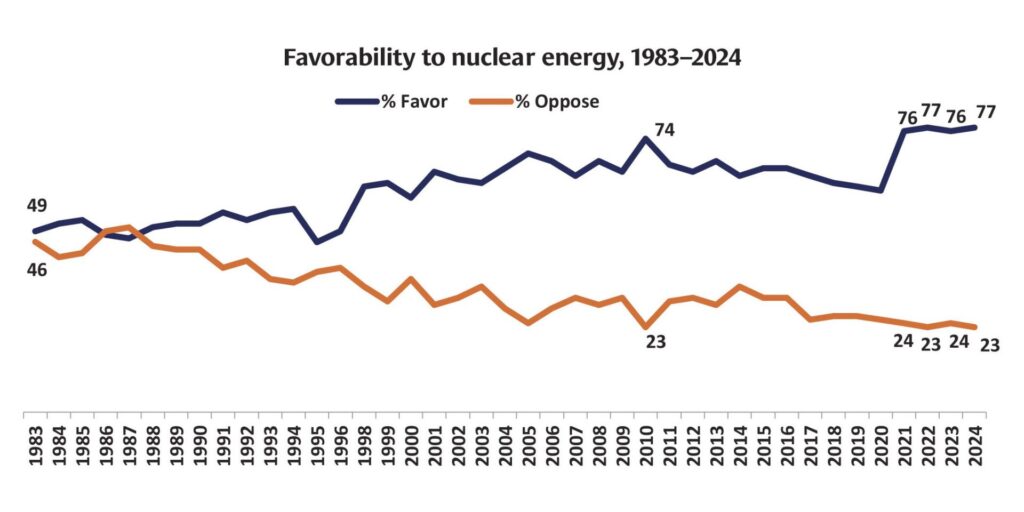
Ann Stouffer Bisconti has been surveying and analyzing the American public’s attitudes and knowledge about nuclear energy for more than four decades. Her research company’s 2024 survey proved to be especially revealing. “The 2024 National Nuclear Energy Public Opinion Survey contained such a wealth of information that I prepared nine reports” to cover all the collected data, she said.
The latest annual Bisconti survey shows that public support for nuclear energy continues to reach record highs, with—for the fourth year in a row—more than 75 percent of respondents indicating that they favor the use of nuclear power. Perhaps most importantly, the responses indicate that increased knowledge about nuclear energy is directly related to increased support. Additional findings shed light on what the public values the most and the least about electricity generation, with affordability and reliability at the top of the list and climate change and land-use “footprint” at the bottom.
Survey methods
The 2024 National Nuclear Energy Public Opinion Survey, conducted April 30–May 2 with results released in May, polled a nationally representative sample of 1,000 adults. Participants are selected on the basis of demographic characteristics and are not aware of the topic until they begin the survey, which they complete electronically. They are paid a small incentive to complete the survey. As the survey progresses, the demographics are monitored to ensure that the final sample is nationally representative. The margin of error for the Bisconti survey results is ±3 percentage points.
Public support of nuclear
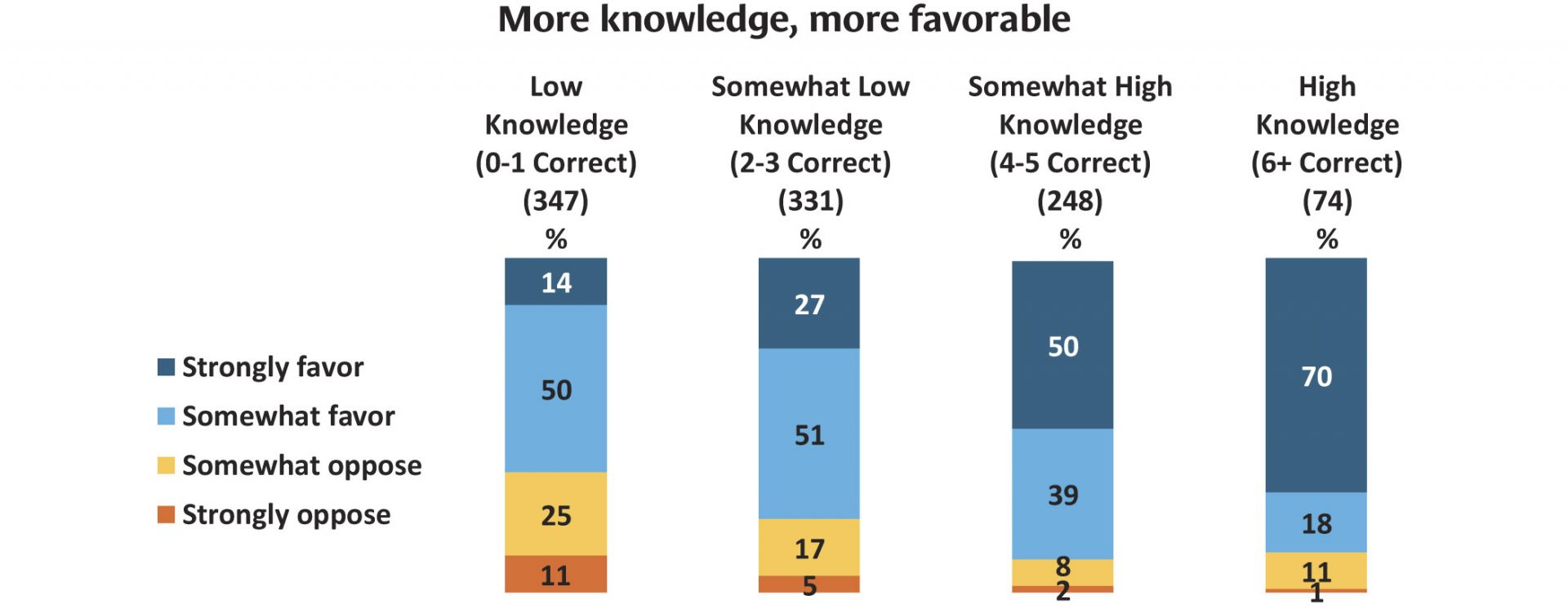
Survey respondents (%) who favor or oppose the use of nuclear energy, according to their level of knowledge (as measured by their score on a 10-question quiz about nuclear energy). (Graph: Bisconti Research Inc.)
This year’s survey indicates that 77 percent of the U.S. public strongly favor or somewhat favor the use of nuclear energy, while 23 percent somewhat or strongly oppose nuclear energy. That level of support matches the 77-percent record high in 2022 and is one percentage point higher than the level recorded in 2023 and 2021. Before 2021, the highest level of support recorded by the Bisconti survey was 74 percent, in 2010.
Bisconti described the recent positive shift in public opinion as “a sea change from three decades ago, when the public was about evenly divided.” Regarding current nuclear supporters and opponents, Bisconti noted that those “strongly favorable to nuclear energy outnumber those strongly opposed by 5 to 1. However, the majority do not have strong opinions. Nearly two-thirds somewhat favor or somewhat oppose nuclear energy; they are fence-sitters and have not yet made up their minds.”
The survey shows that public support for nuclear power plant license renewal and for building more plants also has been at record-high levels for the past four years. Support for license renewal increased from 86 percent in 2021 to 88 percent in 2024, while support for “definitely” building new nuclear plants went from 69 percent in 2021 to 71 percent in 2024. According to Bisconti, in 1998, “when these questions were first asked, barely half the public supported more plants, but support for license renewal has been present all along.”
She added that “the public has always viewed nuclear power plant license renewal as similar to renewing a driver’s license—if you can drive safely, the license should be renewed. More than 90 U.S. nuclear power plants received license renewal[s] over the period of the trend line, with support of the local communities.”
Demographic variables
Survey respondents (%) who favor or oppose the use of nuclear energy, according to their level of knowledge (as measured by their score on a 10-question quiz about nuclear energy). (Graph: Bisconti Research Inc.)
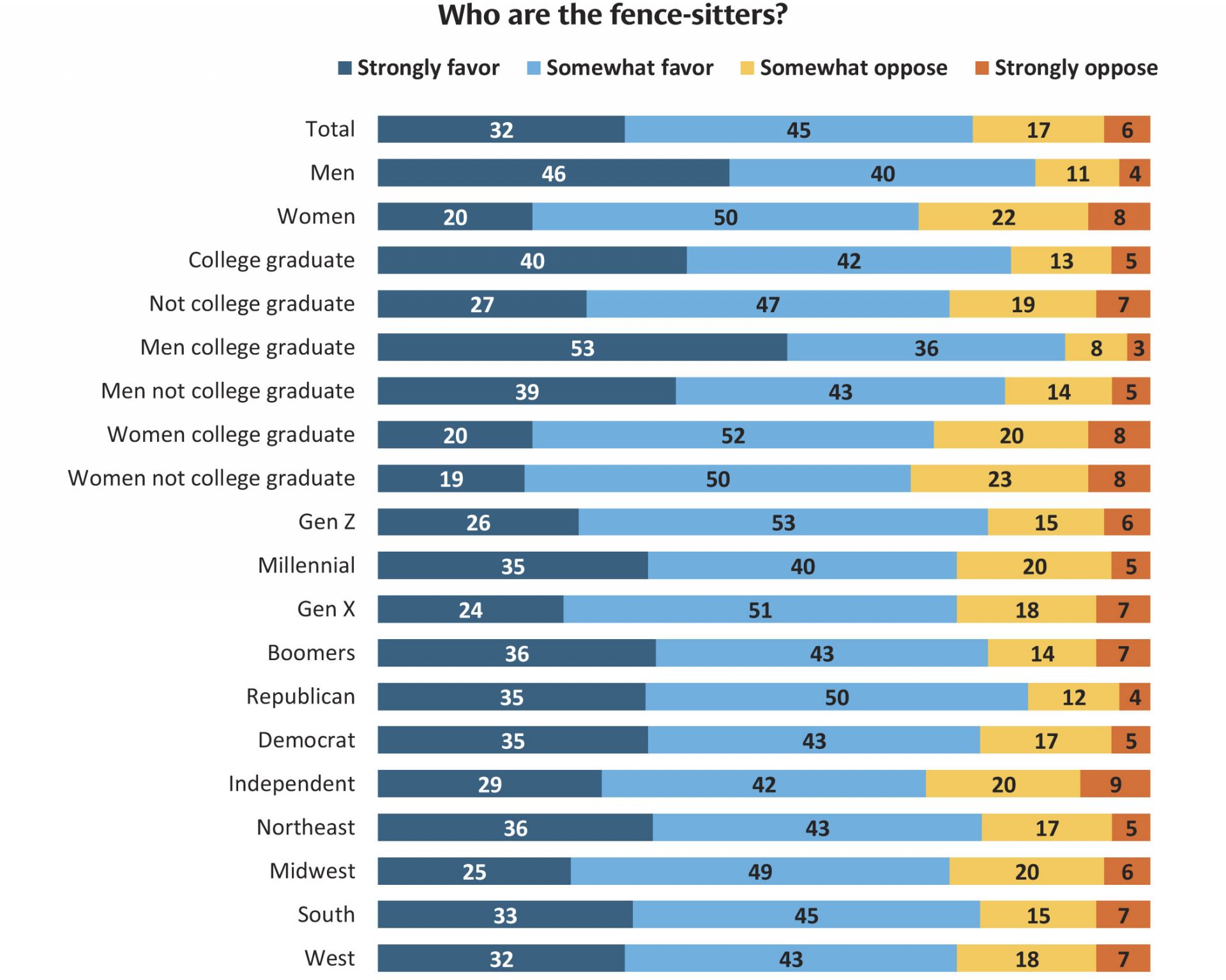
The Bisconti survey breaks down findings by a number of demographic characteristics, including gender, age, education level, political affiliation, and geographic region, and analyzes the relationship between these variables and survey responses. Large majorities of all demographic groups are at least somewhat favorable toward nuclear energy—but the data reveal important differences.
Differences in opinion about nuclear power by gender are striking. Nearly three-fourths of women (72 percent) are fence-sitters with opinions in the middle, compared with half of men (51 percent). Among men, 46 percent strongly favor nuclear, compared with only 20 percent of women. At 53 percent, male college graduates stand out as the demographic group that most strongly favors nuclear.
There are also small differences associated with age. Baby Boomers (people currently 59–77 years old) and Millennials (aged 27–42) show the strongest support for nuclear energy, at 36 percent and 35 percent, respectively. For Gen Z (people up to 26 years old) and Gen X (aged 43–58), 26 percent and 24 percent, respectively, strongly favor nuclear energy. When respondents who somewhat favor nuclear energy are added to these results, support among all age groups rises to about 80 percent—except for Millennials, who hover at 75 percent. (Survey respondents in the Silent Generation—those over 77 years of age—were too few in number for separate analysis.)
The survey found very little difference among self-identified Republicans, Democrats, and Independents. That itself is a big change, as Democrats have historically been more skeptical about nuclear energy. The remarkable jump in support among Democrats began around 2021, a result of expressed concerns about climate change.
Attitudes across geographic regions of the United States were practically identical. That, too, is a change, as the Northeast has historically been less favorable of nuclear energy.
Public knowledge
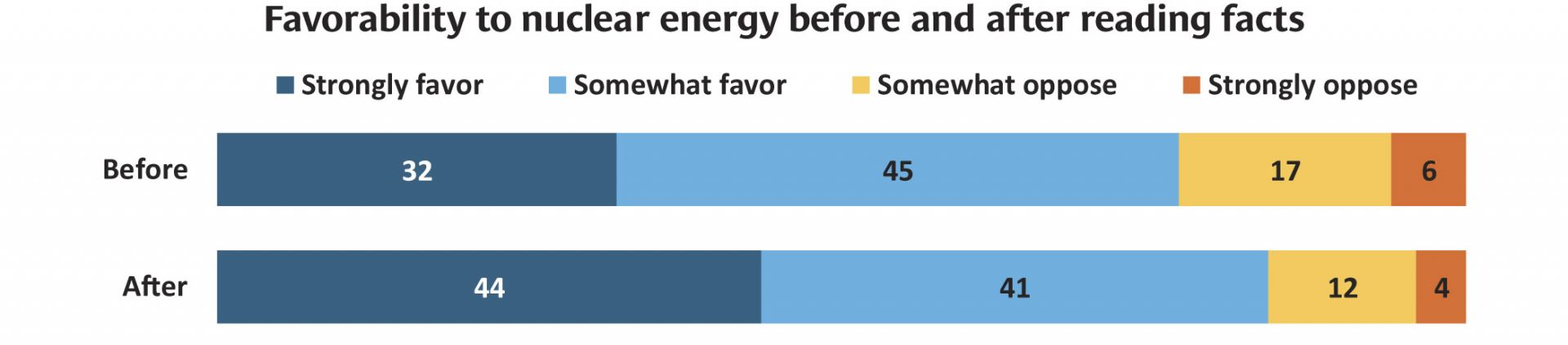
Survey respondents (%) who favor or oppose the use of nuclear energy, shown before and after they were presented with facts about nuclear energy. (Graph: Bisconti Research Inc.)
The more informed people feel about nuclear energy, the more favorable they are. This sentiment has been backed up by previous Bisconti surveys. The 2024 survey took a slightly different approach: Participants’ actual knowledge about nuclear energy was put to the test with a 10-question quiz that covered currently operating plants in the U.S. and internationally, pollution and waste, reliability and efficiency, and regulatory oversight and safety.
Bisconti said that “a range of answers was accepted as correct” for each question. Respondents were grouped into four categories: low knowledge (indicated by score of 0–1 correct answer), somewhat low knowledge (2–3 correct answers), somewhat high knowledge (4–5 correct answers), and high knowledge (6–10 correct answers).
The results indicated the same clear pattern: the more knowledgeable, the more favorable. Among respondents with “low knowledge” about nuclear energy, only 14 percent strongly favor its use, and 50 percent were somewhat favorable. By comparison, among “high-knowledge” respondents, 70 percent strongly favor its use, and 18 percent are somewhat favorable.
The survey shows that the nuclear industry still has a lot of work to do in educating the American people. About two-thirds (68 percent) of respondents demonstrated low or somewhat low knowledge about nuclear energy, compared with only 7 percent who demonstrated high knowledge and 25 percent who showed somewhat high knowledge. “Most respondents failed the test,” Bisconti noted. “When shown facts that corrected these misperceptions, respondents found the information to be new and surprising—and important. The study points the way to addressing the large knowledge gaps that persist.”
The demographic groups showing the greatest percentages of low/somewhat low knowledge are Gen Z (86 percent), women (79 percent), and those without a college degree (76 percent)—all of whom are also largely fence-sitters.
Knowledge gaps
Bisconti noted that on the quiz, “most respondents vastly underestimated the global reach of nuclear energy,” including the number and locations of operating nuclear power plants in the United States and internationally. Results also show that less than 20 percent of the public understands that nuclear is a zero-emission, nearly zero-pollution source of energy. In terms of clean air, the survey participants rated nuclear energy above only natural gas, coal, and oil.
Despite the very reliable nature of nuclear power, only one-third of respondents thought this to be true. Bisconti said, “The comparison with other sources shows that nuclear energy ranks third on reliability [after gas and oil] but with ratings that are not much different from those of sources that operate less than half the time [such as solar and wind].” And while 33 percent of respondents gave nuclear high ratings for efficiency, Bisconti observed that “the ratings were no better than those for reliability. Differences between energy sources are not as large as they should be considering the negative impact of intermittent sources on the electricity system.”
Waste and radiation are two areas of the nuclear enterprise that are still fraught with negative connotations. “Most of the American public cannot accurately visualize nuclear waste, which makes it important to show pictures and models. More people imagine nuclear waste as liquid or gas than solid, and more see it as large and spread out than small and contained,” Bisconti said. There is also general confusion surrounding radiation doses in daily life. “The stigma of radiation continues to attach to nuclear power plants,” she continued. “In comparison with three other possible sources of radiation, only 17 percent answered correctly that living next to a nuclear power plant for a year would give a person the least radiation; 39 percent thought . . . [it] would give a person the most radiation.”
After the quiz, nuclear facts were shared with survey respondents, who were then asked rate each fact on the degree to which it was new and surprising and on its importance. Below are some of the statements that respondents judged to be both new and surprising and very important.
The Nuclear Regulatory Commission inspects and monitors each nuclear power plant daily. If a nuclear power plant is not operating safely, the regulator will order changes or shut it down.
Radiation is easily detected and precisely measured. Living next to a nuclear power plant for a year gives a person less radiation than one cross-country airplane flight.
Nuclear waste does not have to be wasted: the technology exists to recycle used nuclear fuel for electricity and other beneficial uses.
Advanced-design nuclear power plants can be used to make heat and to provide clean drinking water, as well as for electricity.
Nuclear energy is America’s largest source of clean energy—46 percent in 2023; wind is second, with 25 percent in 2023. Nuclear energy also is a reliable and efficient source that produces electricity 24/7.
After respondents received and rated these facts, the initial question regarding favorability of nuclear was repeated. At the beginning of the survey, they expressed largely favorable attitudes, but with many fence-sitters. After the quiz and presentation of facts, there was a 12-point jump in respondents who were strongly favorable as well as a 7-point drop in those who opposed nuclear energy. The largest positive changes were observed among women, Baby Boomers, Republicans, Independents, and people not living in the Northeast.
“Most Gen Z respondents failed the knowledge test at the start of the interview, but few were moved by the facts,” Bisconti observed. “This group may be more skeptical of information, unless it is provided by a trusted source.” Other demographic groups were more receptive to factual information, leading Bisconti to conclude that “favorability to nuclear energy is mushy” because “many members of the public are poorly informed about the energy source. Their opinions are changeable, and information can make a large difference in solidifying favorable opinions.”
Public values
Knowledge boosts support
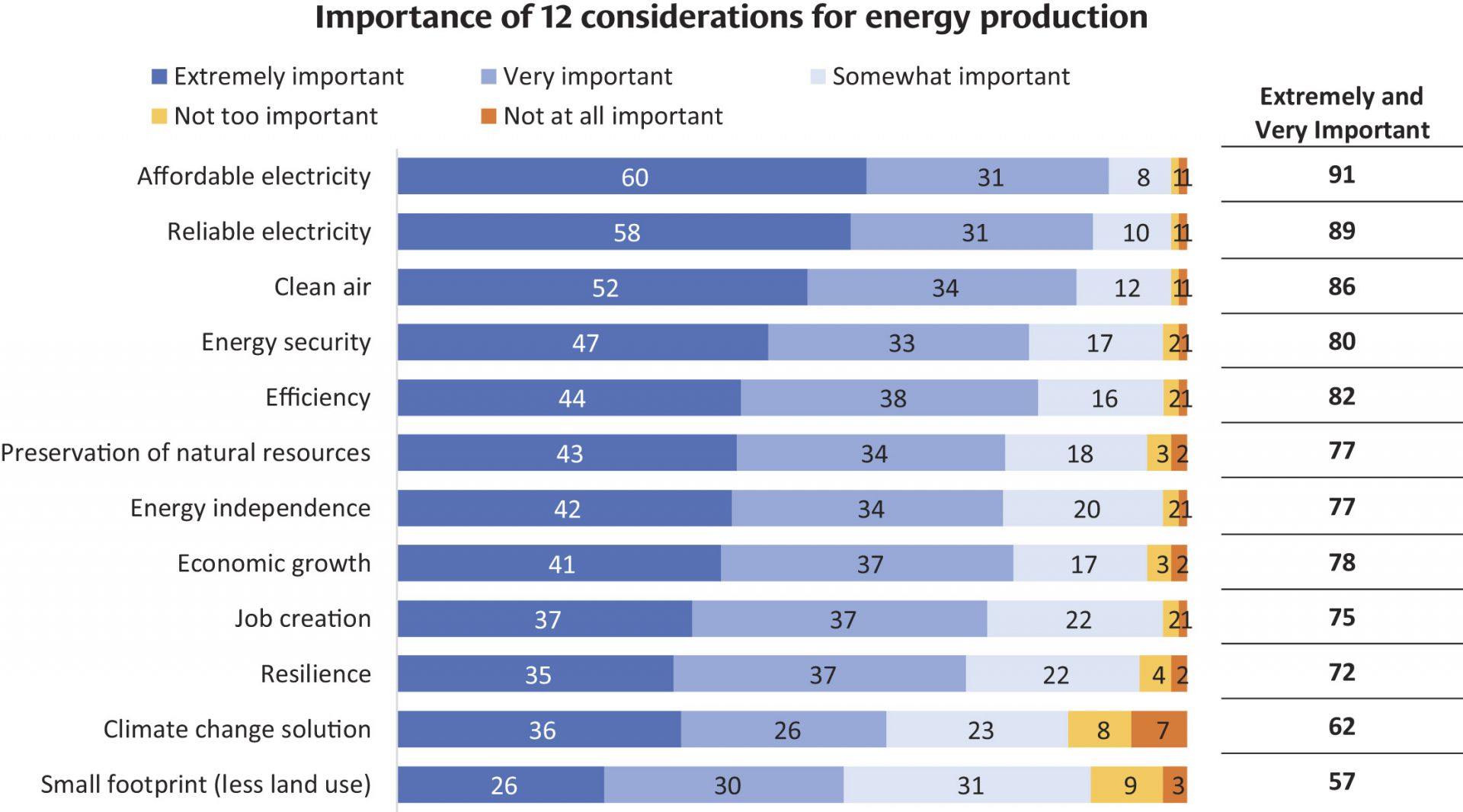
The opinions of survey respondents (%) on 12 considerations for electricity production, ranked from “not important at all” to “extremely important.” (Graph: Bisconti Research Inc.)
Before delving into nuclear energy, the Bisconti survey focused on what the American people care about regarding electricity production. Insights gained from these responses help link public communications to broader public values. Participants were asked to rate the importance of 12 considerations regarding the ways in which electricity is generated: affordability, reliability, clean air, energy security, efficiency, preservation of natural resources, energy independence, economic growth, job creation, resilience, climate change solution, and small footprint (less land use).
Affordability (91 percent of respondents), reliability (89 percent), clean air (86 percent), efficiency (82 percent), and energy security (80 percent) were the top-rated “extremely important” and “very important” considerations. Next were economic growth (78 percent), preservation of natural resources (77 percent), energy independence (77 percent), job creation (75 percent), and resilience (72 percent), which were trailed by climate change solution (62 percent) and small footprint (57 percent).
There was a decrease of around 5 percentage points in the value of climate change from the 2021–2023 surveys. Bisconti commented that “despite much media coverage . . . climate change is a politically charged issue, with a great gap between Democrats and Republicans.”
Expounding on the relationship between survey respondents’ values and their politics, Bisconti observed, “Affordability and reliability dominate for both men and women and those with different political affiliations. Women and Democrats give higher value to environmental considerations—clean air, preservation of natural resources, climate change solution, and small footprint. Independents sit between Democrats and Republicans on these environmental considerations.”
Strong, consistent messaging
A key truth revealed by this year’s survey is that more education will prove beneficial for the nuclear industry. Insufficient public understanding of the benefits of nuclear energy adversely affects public support, Bisconti pointed out, noting that all 12 considerations included in the survey “are characteristic of nuclear energy, although nuclear energy was not mentioned before or with the question.” The nuclear industry needs to do a better, more effective job of linking nuclear energy with positive values in the public mind.
Bisconti also noted, “Nuclear energy’s essential role as a major source of clean energy is increasingly recognized internationally and in the United States, but the U.S. public has not yet caught up with world leaders. Clean air is one of the most valued considerations in electricity production. . . . However, in the quiz, only 18 percent knew that nuclear energy emits no air pollution or, arguably, a tiny amount. When presented with information about nuclear energy’s clean air role, majorities rated the information both highly surprising and highly important.”
Bisconti emphasized, “The goal should not be just to achieve a certain percentage in favor. It should be to achieve a much larger percentage of the public who are strongly favorable and well-informed. Those are the ones who will be with you over time. The survey reveals knowledge gaps that the nuclear enterprise could target through education. Focusing on those facts that respondents found new, surprising, and important in this survey could lead to strengthened public support.”
Bisconti and her company
Bisconti, who has a doctorate in social science research, was recruited in 1983 to be vice president for research and program evaluation with a new organization founded by nuclear utility executives, led by Duke Power’s Bill Lee, to upgrade industry communications about nuclear energy. That organization was a predecessor of the Nuclear Energy Institute. Bisconti was “charged with developing a research program so robust that it would provide blueprints for communications on all nuclear energy topics,” she said. As part of the program, national surveys and focus groups were conducted multiple times a year, and national surveys of nuclear plant neighbors were released every other year. The program also tested and evaluated all potential communications.
Bisconti founded Bisconti Research Inc. in 1996 to continue her research and to gain additional knowledge for individual nuclear energy companies. Bisconti Research’s findings have since provided a comprehensive understanding of public opinion regarding nuclear energy, thereby aiding the industry in its communications.
In 2019, the American Nuclear Society honored Bisconti with its Walter H. Zinn Medal for her “demonstrated leadership in public opinion and communication issues and her commitment to mentoring of future leaders” and for her “outstanding contributions to the advancement of nuclear energy in the U.S. and around the world.” Bisconti has also served two terms on the ANS Board of Directors.