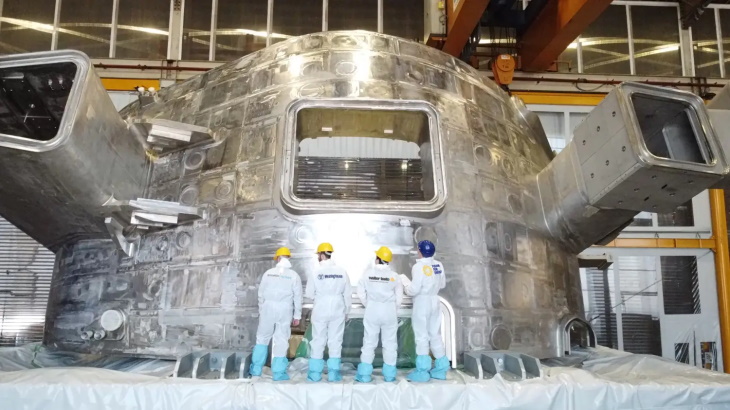
Fusion for Energy (F4E), working alongside the AMW consortium – comprising Ansaldo Nucleare, Westinghouse, and Walter Tosto – has finalized the production of the second European sector for the Vacuum Vessel of the International Thermonuclear Experimental Reactor (ITER). This milestone marks another step forward in the global fusion project.
The ITER vacuum vessel, which forms the plasma chamber, contains the fusion reactions and serves as the primary safety barrier. Spanning an interior volume of 1400 cubic meters, it consists of nine steel sectors, each wedge-shaped, standing over 14 meters tall and weighing 440 tonnes. Once fully assembled, the vessel will measure 19.4 meters in outer diameter and 11.4 meters in height, with a total weight of around 5200 tonnes. Adding internal components like the blanket and divertor will bring its weight to 8500 tonnes.
Each sector is built from four segments, requiring over 1.6 kilometers of welding to piece together. Achieving tolerances of just a few millimeters is critical for fitting internal parts seamlessly, calling for sophisticated forming and welding techniques.
Responsibility for crafting the vacuum vessel sectors is split between Europe, tasked with five, and South Korea, assigned four. Originally, South Korea’s agreement with the ITER Organization covered two sectors, but a 2016 amendment shifted two additional sectors from Europe’s quota to South Korea. They completed their share, delivering the first sector in 2020 and the last in November of the previous year.
F4E, the ITER Organization’s European arm, oversaw the completion of its first sector in Italy last September, which was then shipped to the project site. Now, with the second sector ready, Europe continues to advance its contribution to this ambitious endeavor.