
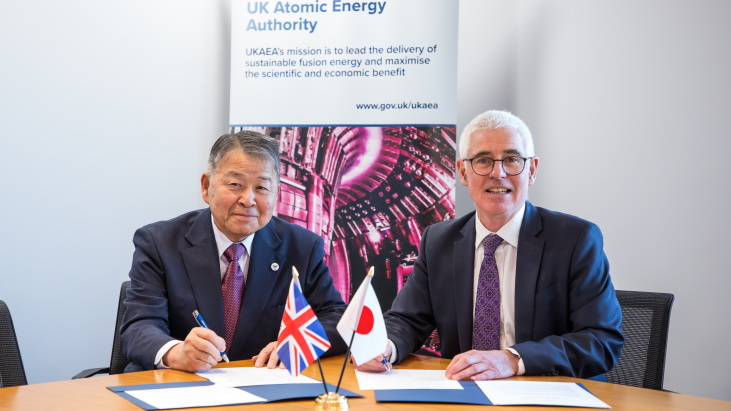
The Fukushima Institute for Research, Education and Innovation in Japan and the United Kingdom Atomic Energy Authority have formalized a partnership to explore robotics and autonomous systems together. Their focus includes practical uses like nuclear decommissioning. The agreement was sealed on March 4 by Koetsu Yamazaki, president of the Fukushima Institute (F-REI), and Rob Buckingham, executive director of UKAEA, during an F-REI team visit to the UKAEA’s Culham Campus in Oxfordshire, England.
This collaboration opens doors for shared projects and scientific progress in several fields. It covers robotics and autonomous tools for dismantling nuclear sites, operating in tough conditions, and improving manufacturing techniques. It also involves managing research facilities, exchanging ideas on best practices, and fostering innovation with an eye toward real-world applications. Plus, it aims to build talent through partnerships and skill-building programs.
The UKAEA leads fusion energy research for the UK government, managing the nation’s fusion efforts. Since 2014, its robotics hub, RACE (Remote Applications in Challenging Environments), has pioneered solutions for harsh industrial settings where humans can’t easily work. One standout success is the LongOps project, backed by the UK’s Nuclear Decommissioning Authority (NDA), UK Research and Innovation, and Japan’s Tokyo Electric Power Company (Tepco). It delivered advanced robotics for decommissioning tasks, proving their worth in real scenarios.
UKAEA also teams up with the NDA, Sellafield Ltd, and the University of Manchester in the Robotics and Artificial Intelligence Collaboration (RAICo). This group speeds up the use of robotics and AI to tackle common hurdles in nuclear cleanup and fusion engineering.
On the Japanese side, F-REI was set up in April 2023 under a law to rebuild Fukushima after the disaster. It’s tasked with becoming a global leader in creative recovery. The institute dives into five main areas: robotics, agriculture and fisheries, energy, radiation science with medical and industrial applications, and gathering insights from nuclear incidents to share worldwide.
What ties these efforts together?
Both groups bring expertise to the table. UKAEA’s RACE has years of experience crafting tools for extreme environments, while F-REI builds on Japan’s push to innovate post-Fukushima. Their combined work could reshape how robotics handle nuclear challenges.
Getting involved is straightforward. The memorandum lays out a clear path: joint studies, shared facilities, and skill exchanges. It’s built to spark progress without overcomplicating things. For those tracking robotics, this partnership signals practical advances ahead.
The materials fueling this research aren’t flashy but effective. Think sensors, lightweight alloys, and durable plastics – stuff that stands up to radiation and tight spaces. These aren’t just lab toys; they’re designed for gritty, real-world jobs like dismantling old reactors or managing fusion sites.
This UK-Japan tie-up blends know-how from two nations with a stake in nuclear futures. It’s less about grand promises and more about getting the work done – whether that’s cleaning up past messes or powering tomorrow.