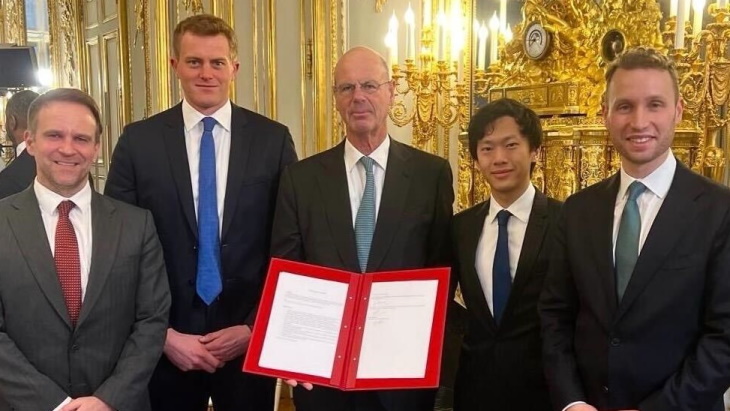
Fluidstack, a UK-based AI cloud provider, has signed a memorandum of understanding with the French government to construct one of the world’s largest decarbonised AI supercomputers in France. At the same time, utility EDF has pinpointed four sites on its own land for data centre projects. The agreement was announced at the AI Action Summit in Paris, hosted by President Emmanuel Macron, and signed by French Minister of Economy, Finance, and Industrial and Digital Sovereignty Eric Lombard, Minister for Industry and Energy Marc Feracci, and Fluidstack cofounder and President César Maklary.
Fluidstack’s Phase 1, supported by EUR10 billion (USD10 billion) in initial funding with robust financial backing, is set to begin operations in 2026. This phase will accommodate around 500,000 next-generation AI chips, establishing the facility as a key hub in AI infrastructure, advancing France’s technological prominence globally and supporting innovative AI-driven solutions.
Fluidstack noted the supercomputer will harness France’s abundant, carbon-free nuclear energy to provide up to 1 gigawatt of dedicated AI compute power, bolstering France’s position in AI infrastructure, energy security, and digital autonomy across diverse applications for global industries.
Macron emphasized the strategic advantage: “Our controllable, safe, stable, and decarbonised nuclear energy is ideal for scaling AI computing capabilities. This EUR10 billion deal with Fluidstack aligns with my vision. We cannot afford to slow down – the global race for innovation is intensifying, and France must lead the charge in this technological revolution shaping the future.”
New possibilities
EDF, meanwhile, intends to issue a call for expressions of interest, granting digital firms access to sites suitable for new data centres in France. The utility highlighted France’s advantage: access to low-carbon electricity at competitive prices, available consistently around the clock. By offering grid-connected, ready-to-use land, EDF aims to shorten project timelines by several years.
It has designated four industrial sites on its land, with a combined power capacity of 2 GW, and plans to identify two additional sites by 2026 to further expand capacity.